Activity crowds out quality
Dial and connection counts move quickly while the opening, qualification, objection, and close receive inconsistent review.
Give managers a focused review queue and give sellers evidence they can use on the next dial, without relying on random call samples.
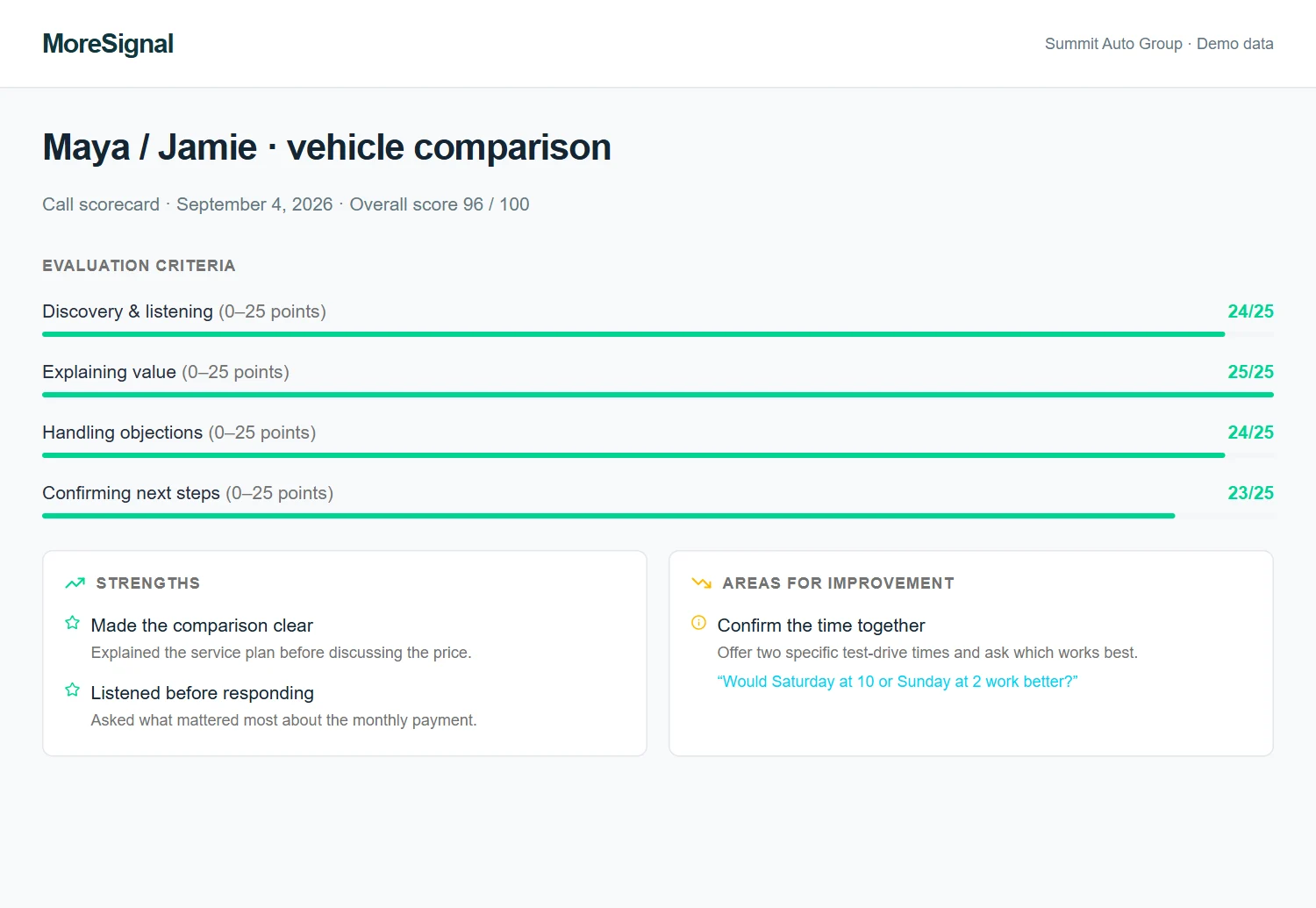
Examples of what a manager might notice and coach. These are illustrative scenarios, not customer results.
Permission opening works
Calls using a concise relevance statement reach qualification more often in the reviewed sample.
Use the sequence as a practice example and validate it across more calls.
Same objection repeats
Sellers answer the surface statement without learning whether timing, value, authority, or trust is underneath.
Practice one diagnostic question before the response.
Meetings are verbally accepted
The buyer agrees in principle, but the calendar invite, participant, or purpose remains unclear.
Add a confirmation criterion and coach the complete handoff.
What needs to improve
Inside-sales, SDR, appointment-setting, and contact-center leaders responsible for repeatable call execution and seller development.
Dial and connection counts move quickly while the opening, qualification, objection, and close receive inconsistent review.
Escalations and memorable losses receive attention while quieter repeatable patterns continue across the team.
Telling a seller to sound more confident or ask better questions gives them little to practice on the next dial.
How it works
1. Route
Use line, seller, source, or other supported rules to apply the appropriate inbound, outbound, or appointment rubric.
2. Prioritize
Use outcomes, scorecard gaps, objections, and missed commitments to narrow the manager's review queue.
3. Reinforce
Coach a specific phrase or sequence and inspect whether execution improves across the seller's next conversations.
In the product
Evaluate clarity, relevance, permission, and whether the seller earns enough attention to continue.
Score fit, need, timing, stakeholder, and next-step discovery according to the team's actual motion.
Find repeated concerns and inspect whether sellers diagnose, respond, and confirm resolution.
Check for a specific day, time, participant, confirmation path, and seller-owned follow-up.
Connected tools
Put the standard to work
Review relevance, qualification, problem depth, concern handling, and a complete appointment.
Open resourceTrace each score and coaching recommendation back to the conversation evidence.
Open resourceCopy a weighted rubric for discovery, impact, qualification, and next steps.
Open resourceQuestions
Yes. Teams can create separate rubrics and assignment rules for different lines, sellers, sources, and call outcomes.
Yes. Teams can score the appointment attempt and surface calls where interest was present but a complete commitment was missing.
No. The score creates a consistent review starting point. Managers should inspect the evidence and apply business context, especially for high-impact decisions.
Bring one real coaching question
Explore the plans, or book a free 20-call review to find a useful coaching priority for your team.