Managers review a tiny sample
A few memorable calls shape the coaching agenda while repeated patterns across the rest of the team remain invisible.
Replace sample-based reviews and vague manager notes with consistent scores, exact evidence, and one useful coaching priority for the next call.
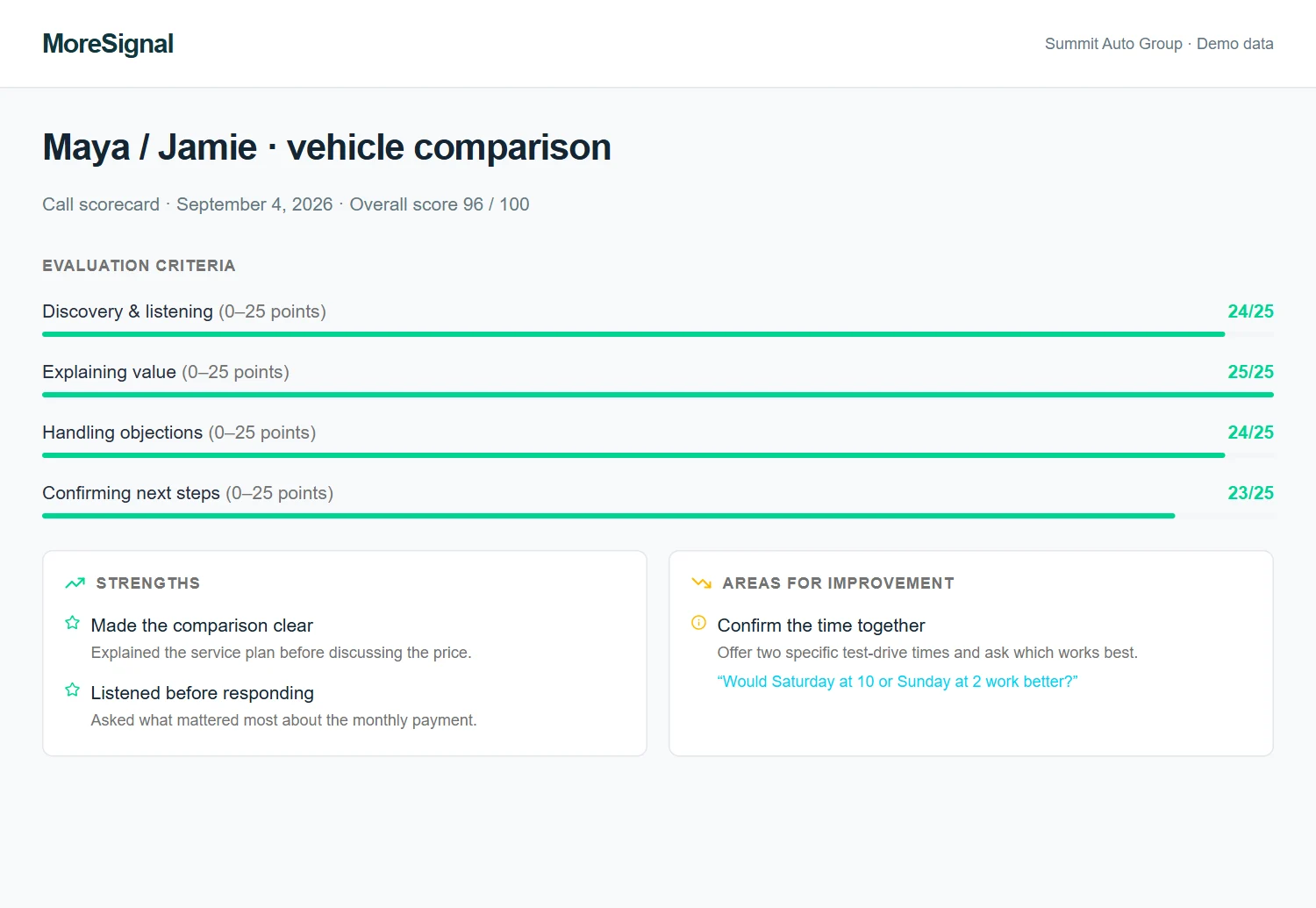
Examples of what a manager might notice and coach. These are illustrative scenarios, not customer results.
Buyer named a deadline
Timeline was discovered, but the rep did not connect it to an agreed decision step.
Practice confirming a dated next action before the conversation ends.
Pricing concern repeated
The rep answered with features instead of clarifying the buyer's cost or risk concern.
Ask one diagnostic question before choosing the response.
Meeting ended positively
Interest was present, but ownership and calendar timing remained ambiguous.
Convert verbal interest into a named owner and date.
What needs to improve
Sales managers and enablement leaders who need a consistent review standard across more calls than a human team can inspect manually.
A few memorable calls shape the coaching agenda while repeated patterns across the rest of the team remain invisible.
Two managers can hear the same call and apply different standards, making trend lines difficult to trust.
A number without the exact supporting moment feels arbitrary and gives the seller little to practice next.
How it works
1. Bring in the call
Import phone, meeting, transcript, or supported in-person conversation data into one coaching workspace.
2. Apply the right standard
Assignment rules select the appropriate scorecard, then outcome detection determines which criteria apply.
3. Inspect the evidence
Each criterion includes the transcript evidence, strengths, misses, and a focused coaching action.
In the product
Score only what makes sense for the detected outcome instead of penalizing voicemails or callbacks as if they were full sales calls.
Give discovery, qualification, objection handling, and next-step behaviors the importance your process requires.
Keep human judgment in the loop with review workflows and transcript context instead of treating an AI score as unquestionable.
See recurring strengths and coaching needs across a rep, team, rubric, or period rather than reacting to one call.
Connected tools
Put the standard to work
Use a practical 100-point standard for reviewing real sales conversations.
Open resourceTrace each score and coaching recommendation back to the conversation evidence.
Open resourceCopy a weighted rubric for discovery, impact, qualification, and next steps.
Open resourceQuestions
Yes. Rubrics can use your criteria, weights, scoring guidance, indicators, and conditional rules so the standard reflects your actual process.
No. Scoring rules can assign different rubrics, and outcome detection can apply only the criteria relevant to what happened on the call.
Yes. Managers can inspect the transcript evidence and use the result as a consistent starting point for human coaching and review.
Bring one real coaching question
Explore the plans, or book a free 20-call review to find a useful coaching priority for your team.