Conversation data becomes another dashboard
Teams collect recordings and metrics without turning them into a clear manager agenda or seller behavior.
See what buyers repeatedly ask, where opportunities lose momentum, which seller behaviors work, and what the team should change next.
Examples of what a manager might notice and coach. These are illustrative scenarios, not customer results.
Implementation timing asked repeatedly
Timeline is a frequent buyer concern, but sellers answer it inconsistently and rarely confirm the decision impact.
Create one approved response and add a follow-up question about the buyer's required date.
High scores share one behavior
Top discovery calls consistently recap the buyer's priority before presenting the approach.
Add the recap to the coaching standard and the next team practice.
Qualified calls stall after interest
Buyers express fit, but the next step lacks a participant, owner, or date.
Update the mutual-next-step criterion and route current opportunities for follow-up.
What needs to improve
Revenue leaders and sales managers who need to connect individual call coaching with patterns across buyers, sellers, and the operating process.
Teams collect recordings and metrics without turning them into a clear manager agenda or seller behavior.
Questions, competitors, objections, and product language reach leadership through memory instead of a reviewable evidence set.
A rep receives feedback while scripts, qualification rules, enablement, and follow-up workflows remain unchanged.
How it works
1. Observe
Identify questions, objections, competitors, outcomes, commitments, and seller behaviors across supported calls.
2. Verify
Move from an aggregate pattern to the exact call moments behind it before deciding what the pattern means.
3. Change
Coach the seller, update the process, route the opportunity, or keep watching the trend based on the evidence.
In the product
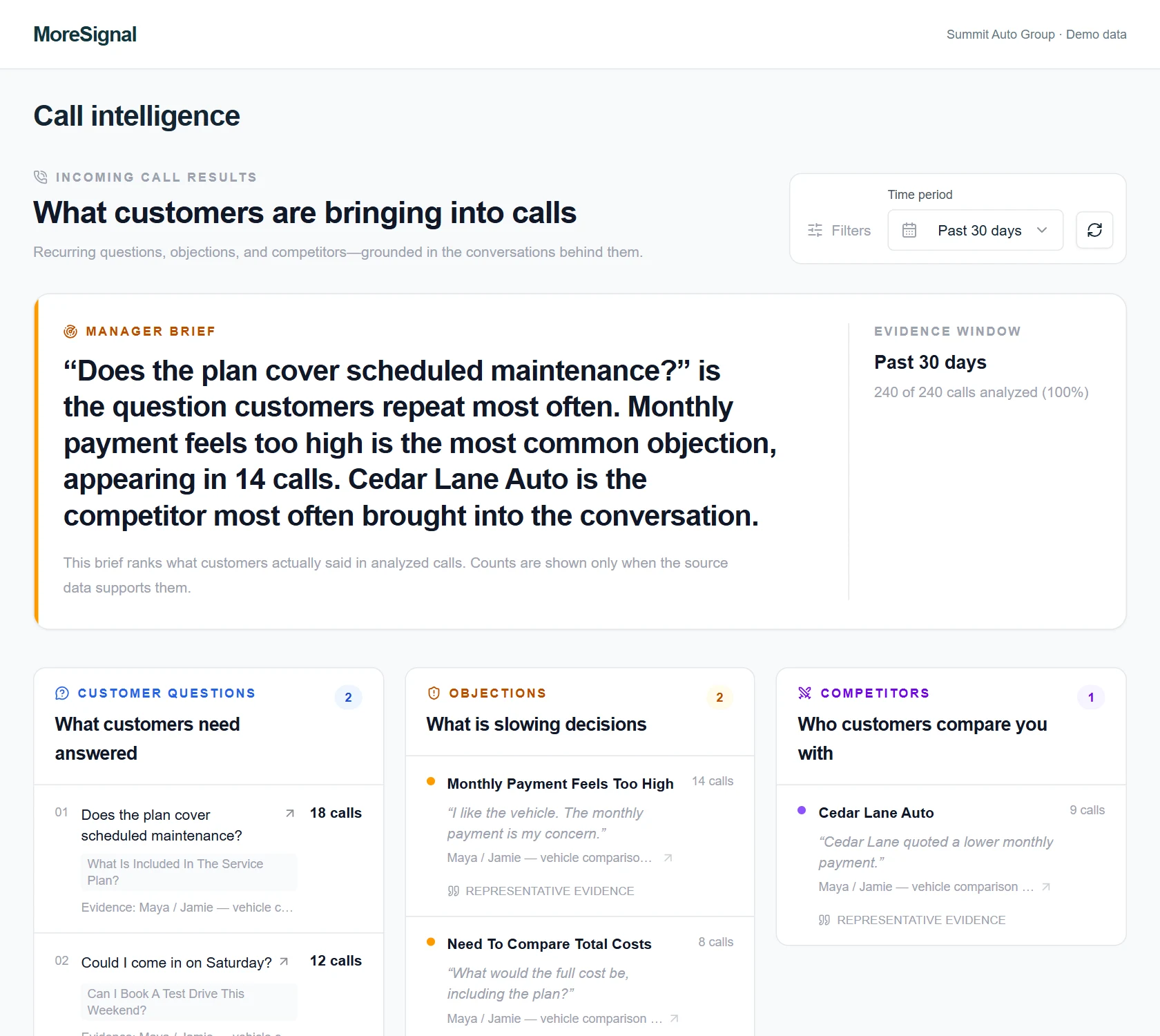
Track recurring questions, objections, competitors, and priorities without separating them from their call context.
Find repeated strengths and misses across scorecard criteria, outcomes, reps, and time periods.
Open the conversation moments behind a finding so leaders can validate the interpretation and hear the buyer's language.
Turn a finding into opportunity follow-up, a coaching action, or a change to the team's sales process.
Connected tools
Put the standard to work
Trace each score and coaching recommendation back to the conversation evidence.
Open resourceCopy a weighted rubric for discovery, impact, qualification, and next steps.
Open resourceUse a practical 100-point standard for reviewing real sales conversations.
Open resourceQuestions
Transcription creates a text record. Conversation intelligence organizes outcomes, signals, patterns, and evidence so a team can decide what to coach or change.
Yes. The workflow is designed to keep surfaced findings connected to the supporting conversations rather than presenting an unexplained aggregate.
No. The system can surface buyer questions, objections, competitors, demand themes, opportunity signals, and process gaps alongside seller behavior.
Bring one real coaching question
Explore the plans, or book a free 20-call review to find a useful coaching priority for your team.