The manager is also carrying a number
Call review competes with pipeline work, customer follow-up, hiring, and the manager's own selling responsibilities.
Turn the calls you already have into a manageable coaching queue, a shared standard, and one specific improvement per seller.
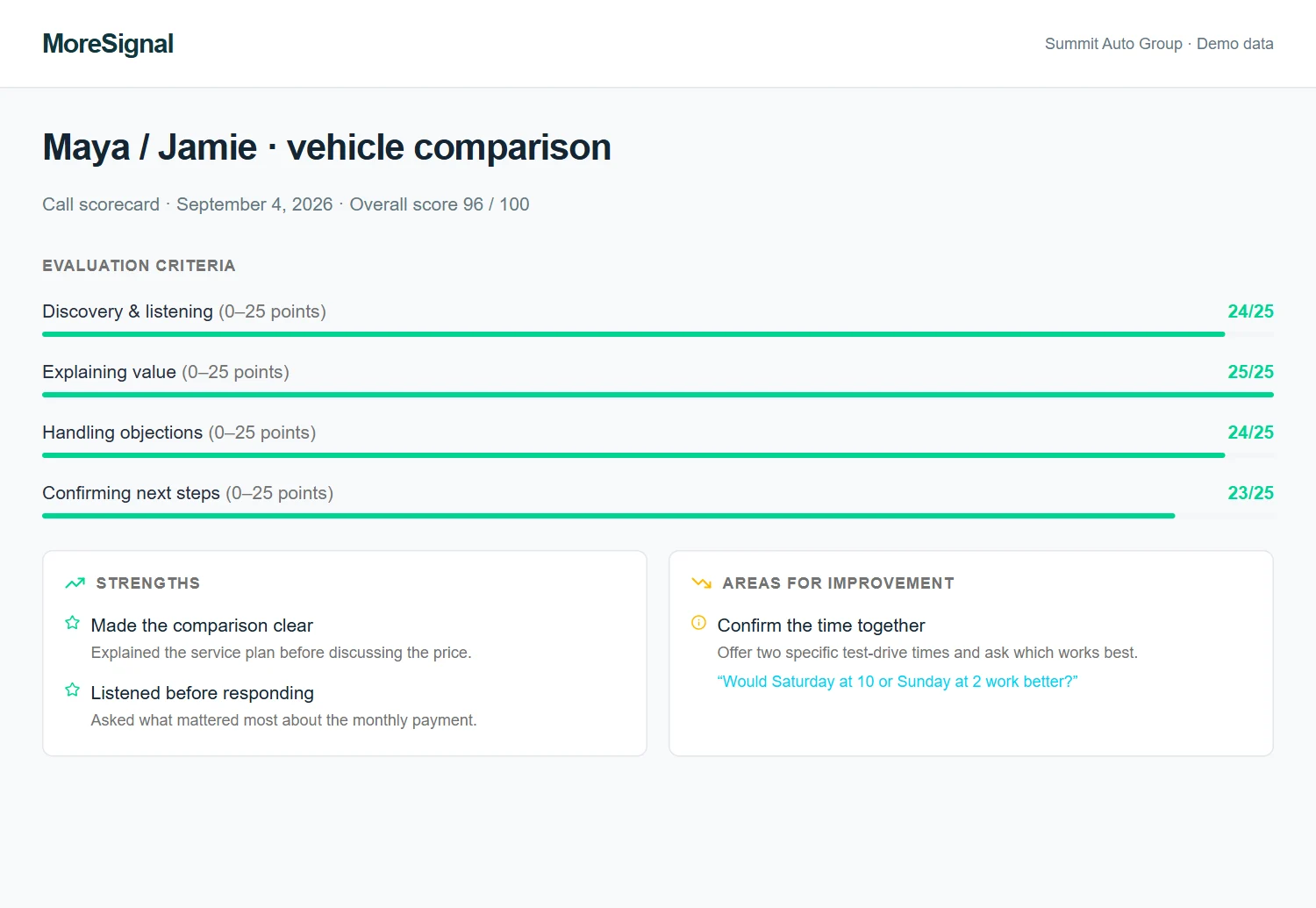
Examples of what a manager might notice and coach. These are illustrative scenarios, not customer results.
Three calls miss the same next step
The issue is repeatable enough to coach, but narrow enough for one practice session.
Practice owner, action, and date before reviewing the next call.
Seller improves discovery score
The rep is asking deeper questions, but value alignment now becomes the next limiting behavior.
Acknowledge the improvement and move the coaching focus forward.
Buyer concern repeats across the team
The objection is not one seller's problem; the team response and enablement material need attention.
Create one response standard and inspect how it performs on later calls.
What needs to improve
Owner-led sales teams and growing revenue organizations that need coaching consistency without the cost and administration of an enterprise suite.
Call review competes with pipeline work, customer follow-up, hiring, and the manager's own selling responsibilities.
Without a repeatable review queue, feedback arrives after escalations instead of reinforcing everyday improvement.
A small team needs useful evidence and actions, not a complex enablement rollout that requires another owner.
How it works
1. Start small
Begin with the calls or meetings already easiest to access and one rubric for the most important sales motion.
2. Build the habit
Use the evidence to choose a focused behavior for each seller instead of assigning a long list of corrections.
3. Expand carefully
Introduce more rubrics, sources, alerts, and workflows only after the first coaching loop becomes useful.
In the product
Create a weighted rubric the manager and sellers can understand, inspect, and improve together.
Start with the relevant criterion and evidence instead of replaying every call from the beginning.
Let sellers see their own call evidence and prepare for a more specific conversation with the manager.
Track whether the selected behavior is changing across later calls instead of treating coaching as a one-time note.
Connected tools
Put the standard to work
Use a practical 100-point standard for reviewing real sales conversations.
Open resourceTrace each score and coaching recommendation back to the conversation evidence.
Open resourceCopy a weighted rubric for discovery, impact, qualification, and next steps.
Open resourceQuestions
Choose one high-value call type, one clear rubric, and a small set of calls. Build a weekly review habit before expanding sources or standards.
No. The product includes optional CRM and pipeline tools, and teams can also use coaching alongside an existing CRM workflow.
The Starter workflow is designed for individuals and small teams, while manager features and broader rubrics become more valuable as the team grows.
Bring one real coaching question
Explore the plans, or book a free 20-call review to find a useful coaching priority for your team.